School Reports: Getting a Makeover
School Reports: Getting a Makeover
Friday, April 09, 2010
While framing the educational policies under the Sarva Shiksha Abhiyaan (SSA), there was a huge requirement for statistical data. The number of schools in a particular stateboth in the rural and urban areas, number of teachers teaching, number of students attending schools at the elementary level and so on. For this purpose, one might have to go through piles of records for days. But now with a mere click, one can access the entire data regarding the number of schools, their grade-wise and level-wise enrollment in states, examination results for the previous academic session for the terminal classes at primary and upper primary levels, classrooms categorized into good or bad condition (requiring minor or major repairs by the school), sex-wise enrollment of children with or without disabilities at primary and upper primary levels, and proportion of teachers undergoing in-service teacher training during the previous year. This has been made possible by the School Report Card Distribution System devised by the National University of Education and Planning (NUEPA) under the umbrella of District Information System for Education (DISE). The School Report Card Distribution System collects and disseminates information in a standardized format from all recognized schools that give elementary level education across the country. If one visits http://schoolreportcards.in/, then one can locate schools, search for relevant information based on ones requirement. The uniqueness of this system has earned itself the sectoral award in education at the 13th National e-Governance Summit.
Constructive Comparison
An innovative effort like this has stemmed
out from the need to make information available for empirical studies. There is
a lot of data floating around, but fetching the relevant data at the right time
has been the main concern. "Even if there has been a lot of improvement in terms
of greater penetration of education at the grassroots, but managing data still
remains the major problem," says Dr Arun C Mehta, PhD (demographic projections),
professor and head, Department of EMIS.
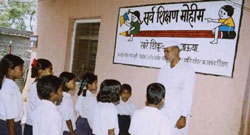
With the increased coverage of schools under DISE, enrollment at the primary and upper primary levels of education has increased significantly. The enrollment has increased from 101.16 mn in 2002-03 to 131.85 mn in 2006-07, and further to 134.38 mn in 2008-09. The gross enrollment at the primary level (as per DISE data) is estimated to be 115.31%. Over a period of time, enrollment in upper primary classes has also shown a consistent increase. From 37.72 mn in 2004-05, it has increased to 53.35 mn in 2008-09. It is clear that based on these kind of data, SSA can frame policies which can be implemented for the benefit of people.
Since the last few years, NUEPA had been recording the number of schools with drinking water facility. Under the policy framework of SSA, Department of Drinking Water Supply under the Ministry of Rural Development is responsible for providing rural schools with drinking water facility. Based on the data provided by the Report Card Distribution System, Department of Drinking Water Supply has provided drinking water facility in schools and colleges. Now about 88% of the 1.29 mn schools that impart elementary education in the country have drinking water facility.
|
|
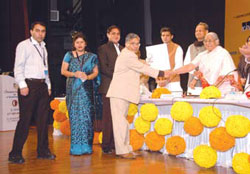
| DISEs School Report Card System won the sectoral award in education at the 13th National e-Governance Summit held in Jaipur recently |
Apart from the quantitative information that helps the policy makers to analyze the prevalent situation in terms of actual numbers, the online report cards provide qualitative information along with a descriptive report about individual schools. The single page online report card is available in seven Indian languages such as Marathi, Telugu, Tamil, Malayalam, Hindi, Gujarati, and Kannada. Presently, it is being planned to add Bengali and Punjabi to the language selection option. The descriptive report is available in English. But work is on to provide it in Hindi.
Efforts and Outcomes
The information related to the report cards is
collected annually (in September) from more than 1.3 mn schools spread over
70,000 blocks in thirty-five states and union territories. This huge data gets
collected, compiled and computerized at the district level. The state project
director is responsible for the verification and collation of the data before
its submission to the national level authorities. It takes almost five months to
consolidate all the data.
To further improve the quality of data, it has now been made mandatory for all the states to check the data on 5% random sample basis through an independent agency each year. States are advised to initiate corrective measures after the findings of sampling come out.
The report card system standardizes the definition of educational variables at the national level. The main aim is to eliminate deterring factors such as lack of co-ordination between multiple agencies involved in the data collection, lack of understanding of the concept and definitions of educational statistics and problems in distribution and collection of data capture formats along with poor dissemination and utilization of data. To add to it, this project involves the automatic generation of descriptive reports which involve the conversion of numbers into words.
Ongoing Challenges
Even though the final data compilation and
processing is done online, the initial collection of data at the block level is
on pen and paper. This is because of the lack of English literacy at the
grassroots. If the system is suddenly changed to an online platform of data
compilation, there is a possibility that the system might collapse. Research is
being carried out to make this system GIS based, wherein schools can be traced
with the help of maps. "Designing and constant monitoring of the website that
deals with bulk data which is to be made available to the user as per the
requirement in a single click has been a major challenge," adds Dr Mehta.
Atreyee Datta
attreyeed@cybermedia.co.in